
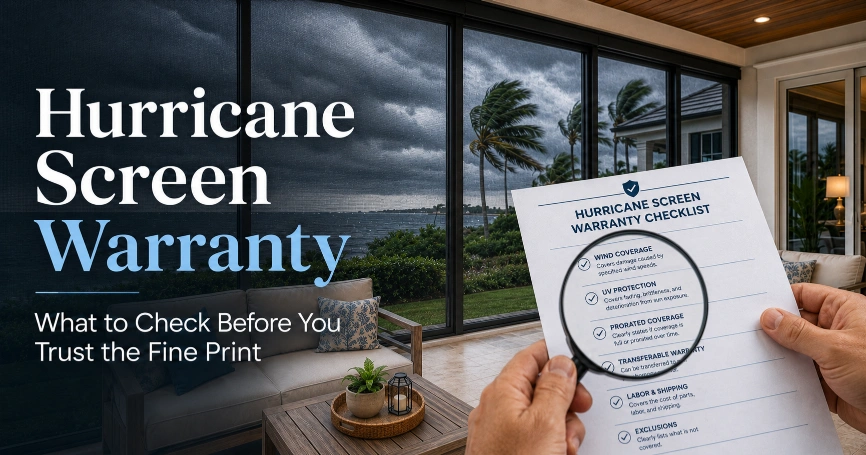
Buying hurricane screens is a serious investment. You compare strength ratings, materials, installation options, appearance, and price.
But there is one thing many homeowners don’t look at closely enough until something goes wrong:
the warranty.
A hurricane screen warranty can sound impressive on a sales page. Five years. Ten years. Limited lifetime coverage.
The problem is that the number of years tells you very little about what will actually happen if your screen fails.
A 10-year warranty does not necessarily mean your screen will be replaced for free for 10 years. Some warranties are prorated, limit how the screen can be used, or exclude certain weather-related damage. Others cover parts but leave you responsible for labor, shipping, or replacement fabric.
So before just comparing warranty lengths, there is a better question to ask:
What is actually covered under my warranty when I need it?
Here’s what homeowners should look for—and why the written warranty behind Atlas Armor hurricane screens deserves a closer look.
1. Start With the Obvious Question: Is Wind Damage Covered?
It sounds almost too obvious.
You’re buying a hurricane screen.
Hurricanes involve extremely high winds.
So naturally, if wind causes the screen to fail, the warranty should cover it…right?
Not necessarily.
Warranty wording varies significantly between hurricane-protection products. Some published warranties contain exclusions for hurricanes, acts of nature, acts of God, natural disaster damage, or severe weather. Atlantic Storm Protection, for example, currently lists hurricane damage among the conditions not covered by its limited warranty.
Other warranties may cover hurricane-related damage but still place restrictions on how the product is used.
That is why you shouldn’t assume anything.
Before purchasing a hurricane screen, ask:
“If wind causes the fabric to pull out of the tracks, separate from the system, or split at a seam, who pays for the replacement?”
Then ask the salesperson to show you the answer and provide you with a copy of the actual warranty before you decide.
This is where Atlas Armor gets interesting.
The Atlas Wind Shield Warranty specifically covers qualifying wind-only fabric failure up to 160 mph.
Atlas defines covered wind-only failures to include situations where the fabric pulls away from the side tracks, bottom-weight bar, or top take-up reel, as well as qualifying horizontal seam separation.
For a hurricane-protection product, that is a meaningful difference.
The warranty is addressing the exact kind of failure a homeowner may worry about when the wind starts getting serious.
2. A Long Warranty Isn’t Always a Strong Warranty
It is easy to compare warranties like this:
Product A: 5 years
Product B: 10 years
Product B must be better.
Unfortunately, warranties rarely work that simply.
A 10-year warranty may be prorated, meaning the amount covered decreases as the product gets older.
For example, a published Armor Screen warranty provides 10-year coverage against manufacturing defects, but describes that coverage as prorated. It also notes that UV damage from extended deployment may not be covered unless the particular screen was designed for that use.
So instead of asking:
“How long is the warranty?”
Ask:
“What will this warranty actually pay for in year eight or year nine?”
Find out whether it covers:
- Replacement fabric
- Components
- Motors
- Labor
- Shipping
- Removal
- Reinstallation
- Dealer service costs
Those details can make a much bigger financial difference than the warranty length printed in large letters.
3. Look Carefully for Usage Restrictions
Another easily overlooked issue is how you are allowed to use your hurricane screens.
Some products are intended primarily for deployment immediately before a storm and removal afterward.
That can create warranty restrictions if you prefer to keep your screens down for shade, privacy, insects, or everyday outdoor comfort.
Cat 5 Hurricane Screens, for example, currently states that its warranty can be voided for abuse that includes deployment for more than 30 days per year.
That doesn’t automatically make it a poor product.
It simply means you need to understand how your intended use matches the warranty.
If you are planning to use your screens throughout the year, ask:
“Can these stay deployed regularly without affecting my warranty?”
That question matters a lot in Florida.
4. What About Years of Florida Sun?
A hurricane may only affect your property occasionally.
The Florida sun is there almost every day.
Hurricane screen fabric can be exposed to:
- Intense UV
- Heat
- Humidity
- Mold
- Mildew
- Salt-air environments
- Atmospheric pollution
Over many years, those conditions matter.
That makes UV protection an important part of the warranty—especially if you expect to use the screens regularly rather than keeping them stored most of the year.
Atlas Armor takes a different approach here.
Its warranty specifically provides qualifying fabric replacement for loss of screen strength caused by normal exposure to sunlight and UV, rot, mold, mildew, and atmospheric chemicals during the warranty period.
Atlas refers to this as its 24/7/10 fabric warranty, meaning the screen is intended to be usable throughout the 10-year warranty period rather than hidden from normal sunlight exposure.
For homeowners who also use hurricane screens for shade, privacy, or everyday outdoor living, this is worth paying attention to.
5. Check Whether Replacement Coverage Is Prorated
Here is another situation homeowners should think about.
Imagine your hurricane screen is eight years old.
The fabric suffers a qualifying failure.
You call the manufacturer expecting a replacement—and discover that the warranty only covers a percentage of the cost because the product is several years old.
That is how prorated warranties can work.
The warranty technically still exists, but your financial responsibility increases over time.
Atlas Armor does not structure its qualifying fabric coverage that way.
For covered wind-only failures, Atlas states that the qualifying fabric will be repaired or replaced free of charge, at the company’s discretion.
The warranty also provides qualifying replacement coverage for the UV, mold, mildew, rot, and atmospheric-chemical conditions described above.
There are still exclusions and additional costs to understand—which we’ll get to—but the replacement fabric itself is not described as a declining prorated benefit.
That makes the coverage easier for homeowners to understand.
6. Will the Warranty Still Exist If You Sell Your House?
Maybe you’re planning to stay in your home forever.
Maybe you aren’t.
Either way, it is worth asking whether your hurricane screen warranty stays with the property.
Some product warranties protect only the original purchaser.
Once the house changes hands, the warranty ends.
That means a screen advertised with a 10-year warranty may effectively have a much shorter warranty if you sell your property after three or four years.
Atlas Armor’s warranty is transferable.
Its 10-year warranty stays with the screen at the original installation location and can transfer to the new homeowner.
The new owner must register with Atlas Armor within 90 days of the property sale to continue the remaining warranty period.
That may also make the hurricane protection system a more attractive feature when selling the property.
Instead of simply telling a buyer that the home has hurricane screens, you can potentially tell them that there is still manufacturer warranty protection remaining.A transferable warranty adds lasting value to your home—giving future buyers added protection, confidence, and a valuable benefit that can help increase your home’s equity and appeal at resale.
7. Be Careful With the Words “Free Replacement”
This is important with any warranty.
“Free replacement” doesn’t always mean the entire process costs nothing.
There may still be charges for:
- Dealer labor
- Removal
- Reinstallation
- Shipping
- Crating
- Handling
- Taxes
- Import fees
Atlas Armor is transparent about this in the written warranty.
Qualifying damaged items may be repaired or replaced free by Atlas after inspection, but the manufacturer warranty does not cover certain dealer labor, shipping, handling, taxes, crating, import fees, and related expenses.
So homeowners should understand the distinction between:
Free replacement fabric
and
A completely free service call.
They are not necessarily the same.
That doesn’t diminish the value of the warranty—it simply means you should know what you may still be responsible for before you buy.
8. Wind Damage and Flying-Debris Damage Are Not the Same Thing
This is another important piece of fine print.
Atlas Armor’s special coverage relates to wind-only fabric failure.
It does not mean that every possible type of damage occurring during a hurricane is covered.
For example, the Atlas warranty excludes certain damage caused by objects striking or rubbing against the fabric, including things such as damaged pool-cage materials, sharp roof tiles, falling trees, construction materials, and storm-surge-driven objects.
That distinction matters.
If extreme wind alone causes a qualifying screen failure, Atlas provides specific warranty protection.
If a tree falls into the screen, that is a different type of event.
Every homeowner should understand that difference before assuming a hurricane screen warranty is unlimited storm insurance.
So, What Should You Check Before Buying?
Don’t just ask the dealer whether the system “has a warranty.”
Ask specific questions:
- How many years does the warranty last?
- Is any part of the warranty prorated?
- Is wind-only failure covered?
- Are hurricanes or extreme weather excluded?
- What happens if the fabric comes out of the tracks?
- What happens if a seam separates?
- Is UV deterioration covered?
- Can I leave the screens deployed regularly?
- Are mold and mildew damage covered?
- Does the warranty transfer if I sell my home?
- Is replacement fabric included?
- Is labor included?
- Who pays shipping?
- What maintenance is required?
- Do I need to register the warranty?
- What actions could void the warranty?
And there is one question worth asking every hurricane-screen salesperson:
“If wind damages the screen, who pays?”
Then follow up with:
“Can you show me where it says that in the warranty?”
That second question is important.
Sales promises are easy.
Written coverage is what matters.
Why the Atlas Armor Warranty Stands Out
No hurricane screen warranty covers everything, and Atlas Armor’s warranty has exclusions too.
But when you look at the issues homeowners are most likely to care about, Atlas offers several meaningful benefits.
10 Years of Coverage
Atlas provides a 10-year warranty beginning on the installation date, provided the original owner completes the required registration within 90 days.
Transferable to the Next Homeowner
The remaining warranty period can follow the screen when the property changes owners, subject to the new owner’s registration requirement.
Wind-Only Fabric Failure Protection
Qualifying fabric failures caused solely by wind are covered up to the warranty’s stated 160 mph maximum.
UV, Mold, Mildew and Rot Protection
Qualifying loss of fabric strength caused by normal exposure to UV, mold, mildew, rot, and atmospheric chemicals is also addressed by the warranty.
Free Qualifying Fabric Repair or Replacement
For covered fabric failures, Atlas states that it will repair or replace the qualifying fabric rather than requiring the homeowner to purchase another screen panel.
Put together, those details make Atlas Armor’s warranty particularly worth comparing with other hurricane-screen warranties—not simply because it says “10 years,” but because of what those 10 years actually cover.
The Fine Print Matters More Than the Big Number
Choosing hurricane screens is already a significant decision.
The last thing you want is to discover after a major storm that you misunderstood your warranty.
Don’t choose a system based only on:
“10-Year Warranty!”
Look underneath that headline.
Ask what happens if the wind causes a failure.
Ask whether the fabric can live in the Florida sun.
Ask whether coverage decreases over time.
Ask whether the warranty disappears when you sell your home.
And ask what you would actually have to pay if you filed a claim.
A good warranty shouldn’t require you to make assumptions.
It should clearly explain what the manufacturer is prepared to stand behind.
That is one of the stronger aspects of the Atlas Wind Shield Warranty. It specifically addresses wind-only fabric failure, long-term environmental exposure, transferable ownership, and qualifying replacement fabric—all areas that homeowners should investigate before choosing any hurricane-screen system.
Frequently Asked Questions About Hurricane Screen Warranties
Does a hurricane screen warranty automatically cover hurricane damage?
No. Warranty terms vary. Some published storm-protection warranties specifically exclude certain hurricane or natural-event damage, so homeowners should always read the actual terms rather than assuming that “hurricane screen” means every type of hurricane damage is covered.
What is the most important thing to check?
Start with wind-related failure. Ask what happens if wind causes the screen to pull out of its tracks, separate from its attachment points, or suffer a seam failure.
Are all 10-year hurricane screen warranties the same?
No. A warranty may be prorated, limited to defects, contain deployment restrictions, or exclude certain costs. The length alone does not tell you how strong the coverage is.
Does Atlas Armor cover wind damage?
Atlas Armor’s warranty covers specified wind-only fabric failures up to 160 mph, subject to the warranty’s complete terms and exclusions.
Can Atlas Armor hurricane screens stay exposed to sunlight?
Atlas provides qualifying fabric coverage for loss of screen strength caused by normal UV exposure, along with mold, mildew, rot, and atmospheric chemicals, during its 10-year warranty period.
Is the Atlas Armor warranty transferable?
Yes. The remaining warranty period can transfer to a new owner at the original installation location if the new owner registers within the required period.
Does the Atlas warranty cover labor and shipping?
The manufacturer warranty does not cover certain dealer installation labor, shipping, crating, handling, taxes, import fees, and other associated charges.
What should I ask before choosing a hurricane screen?
Ask one simple question:
“If wind causes the fabric to fail, who pays to repair or replace it?”
Then ask to see the answer in writing.


