
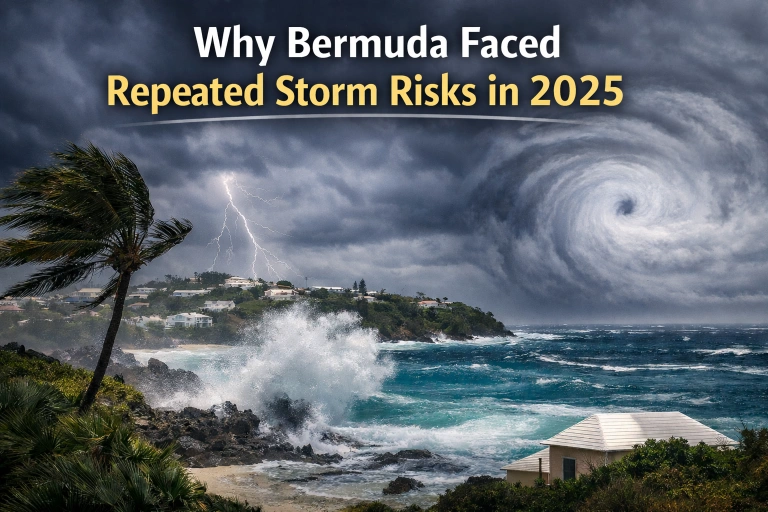
Bermuda faced multiple storm risks in 2025, as the island was exposed to various tropical threats throughout the season. This season was not just about an individual storm making a direct impact. Bermuda dealt with nearby systems, dangerous surf, repeated alerts, strong winds, and changing conditions that kept residents and property owners on edge from late summer into fall.
That is what made the Bermuda hurricane season 2025 stand out. The island faced repeated weather pressure, not one isolated event. Some storms stayed offshore but still created problems. Others came close enough to raise serious concern. At least one system brought a more direct impact. Together, those events showed why storm risk in Bermuda is rarely simple.
For homeowners, businesses, and property managers, the season offered an important reminder. Bermuda does not need multiple direct hits to face multiple storm risks. Its location, coastal exposure, and recurring storm tracks can create real danger in different ways across the same season.
Why is Bermuda so exposed during hurricane season?
Bermuda’s location is one of the biggest reasons it faces repeated tropical threats. Storms in the Atlantic often curve north later in the season, and that puts Bermuda in a position where it can be affected even when the center of a storm does not move directly over the island.
This is important because storm risks in Bermuda are not limited to landfall. Strong surf, rip currents, wind gusts, heavy rain, and rough coastal conditions can all develop when a storm passes nearby. That means the island can experience disruption, property stress, and safety concerns even during a near miss.
Bermuda also feels these threats quickly. A system can seem distant at first, then shift closer, strengthen, or send worsening ocean conditions toward the island. That is why residents often find themselves watching forecasts closely and preparing before a storm appears to be a direct hit.
Why were near misses still a major problem in Bermuda in 2025?
One of the clearest lessons from the Bermuda storms in 2025 was that near misses still matter. A storm passing offshore can still create dangerous conditions across the island, especially along the coast and around exposed outdoor areas.
That matters for both safety and property protection. A storm does not need to cross directly overhead to produce rough surf, strong gusts, water intrusion, or flying debris concerns. In Bermuda, even a slightly offshore track can put pressure on doors, large openings, patios, and exterior spaces that are exposed to the elements.
This is also where people sometimes underestimate risk. A nearby storm may sound less serious than a direct strike, but the practical effects can still be significant. For homeowners looking at how vulnerable exterior areas perform during repeated weather threats, Atlas Armor’s storm protection solutions can help start that evaluation.
How did repeated storm threats make 2025 feel more intense?
A single storm can be stressful. A season with repeated threats feels very different. In 2025, Bermuda had to stay alert through multiple tropical systems and shifting forecasts. That made the season feel longer, heavier, and harder to ignore.
Repeated threats change how people prepare. Instead of securing a property once and moving on, residents may need to check openings again, secure outdoor areas again, and rethink how ready they really are. That repeated cycle can expose weaknesses that might not be obvious during one event alone.
This is one reason Bermuda faced multiple storm risks in 2025 in a way that felt more serious than a normal season. The risk kept returning. Every new storm brought another layer of concern, and that constant pressure tested not only buildings but also preparation plans.
What did offshore storms reveal about Bermuda’s real storm risk?
Offshore storms revealed that Bermuda’s real storm risk is broader than many people think. A storm does not have to make direct landfall to affect daily life, coastal safety, or the condition of a property.
This was one of the most important takeaways from the Bermuda hurricane season 2025. Storm activity around the island brought surf hazards, weather alerts, and concern about how exposed features would hold up if conditions worsened. That included patios, lanais, exterior doors, and large openings that are often the first parts of a property to feel pressure.
Living in Bermuda means living with the ocean close by. That is part of the island’s appeal, but it also means that coastal exposure plays a major role in storm season. Wind and rain are part of the story, but so are wave action, salt exposure, and the way nearby storms can still create dangerous conditions.
Why did 2025 raise more questions about property protection in Bermuda?
Because repeated storm threats force people to think beyond temporary preparation. They raise bigger questions about what parts of a property are truly vulnerable and what should be strengthened before the next active season arrives.
In 2025, Bermuda property owners had more than one reason to ask those questions. When one storm is followed by another, it becomes easier to see where weak points exist. A door that seemed fine in normal weather may not feel as reliable under repeated wind pressure. An outdoor living area may suddenly look much more exposed. A large opening may no longer seem like something to deal with later.
That is where long term planning starts to matter. For many properties, the goal is not just to get through one storm. It is to be better prepared for the next one too. Atlas Armor offers hurricane protection solutions for homeowners and commercial properties that need stronger exterior defense before another active season begins.
Which parts of a Bermuda property are most vulnerable during storm season?
The most vulnerable areas are usually the ones people use every day and think about the least when the weather is calm. Large openings, patio enclosures, lanais, exposed doors, and exterior spaces often become the most important areas to protect once storm conditions start changing.
These spaces can be vulnerable for a few reasons. They are often wide, open, and directly exposed to wind and rain. They also tend to connect indoor comfort with outdoor living, which makes them more difficult to secure if the property was not designed with storm resilience in mind.
When Bermuda faces repeated tropical threats, these weak points matter even more. The issue is not only whether one storm causes damage. It is whether repeated exposure reveals growing stress on the parts of a property that face the weather first.
What is the biggest lesson from Bermuda storms in 2025?
The biggest lesson is that Bermuda storms in 2025 showed how layered storm risk can be. The season was not only about direct impact. It was also about repeated exposure, nearby storm tracks, surf danger, wind pressure, and the way changing forecasts can keep an island under stress for weeks.
That is why Bermuda faced multiple storm risks in 2025. It was a mix of geography, ocean exposure, and a season that brought more than one meaningful threat. Some storms stayed close enough to create dangerous conditions. Others pushed residents into a higher level of preparation. Together, they showed why Bermuda storm planning has to go beyond waiting for a direct hit.
For homeowners and commercial property owners who want to prepare earlier and more effectively, this is a smart time to contact Atlas Armor and look at ways to strengthen the parts of a property that are most exposed.


